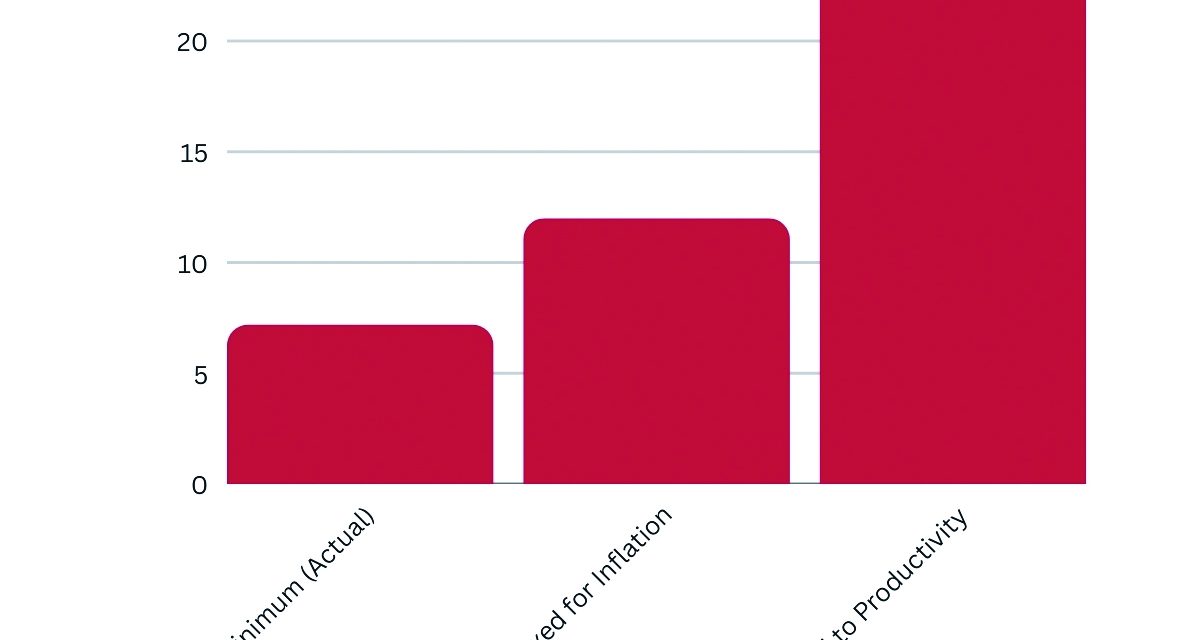
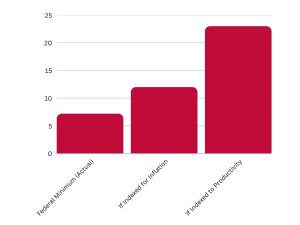
The United States is heading into 2026 with a federal minimum wage frozen at $7.25 an hour since July 2009—a wage so outdated that it no longer serves as a baseline for dignified work. Over the past 17 years, the costs of housing, food, transportation, and health care have surged, while the wage floor has remained unchanged. Workers today are effectively paid less in real purchasing power than minimum-wage workers in the 1960s.
If the minimum wage had kept pace with inflation, it would be well over $12 an hour today. If it had tracked the growth of worker productivity—the value employees generate for employers—it would now be in the range of $22–$25 an hour. That number is not a coincidence: it is the range many economists say would be necessary in 2026 for a single adult to meet basic needs without public assistance.
And that is where the country finds itself. Corporations that long resisted raising wages are finally advertising “competitive” starting pay of around $20–$23 an hour, not because they are suddenly committed to lifting workers out of poverty, but because that is simply what the minimum wage should be in 2026 if it had grown at even a modest, historically normal rate.
The Amazon Example — Poverty Wages Marketed as Generosity
Amazon—one of the largest employers in the United States—has recently highlighted that its average starting wage now exceeds $23 an hour. At first glance, this sounds like progress. But a closer look reveals a more troubling truth: Amazon isn’t leading; it is catching up to the bare minimum that the federal government should have set years ago.
With rent up dramatically over the past decade, groceries rising nearly 25 percent since 2020, and transportation, utilities, and childcare costs climbing steadily, a $23 wage does not stretch as far as employers claim. A full-time worker earning $23 an hour brings home about $47,800 a year before taxes—well below what most economic models define as a “living wage” for a family in nearly every region of the country. For many households, that income still qualifies them for public assistance.
Corporations framing $23 an hour as a transformative, family-supporting wage is at best misleading. In reality, they are paying 2026 workers what the minimum wage should already be, while continuing to oppose federal wage standards that would ensure all workers—not just those employed by massive multinationals—earn a fair baseline income.
Seventeen Years Without an Update Is a Policy Choice
America’s wage floor did not stagnate by accident. Congressional inaction — driven largely by lobbying from the same corporations now boasting about their pay—has held the minimum wage flat while inflation has steadily eroded its value. The result is a growing gap between what workers earn and the actual cost of living.
Meanwhile, 30 states and dozens of cities have raised their own minimum wages to reflect economic reality. Their economies have not collapsed. Instead, workers spend more locally, businesses experience lower turnover, and communities benefit from greater financial stability. The federal government remains the outlier.
Workers Are Producing More and Receiving Less
 Today’s workers are more productive, more technologically skilled, and more efficient than ever before. But the economic gains generated by their labor have increasingly flowed upward, not back to the people who create the value. The decoupling of productivity and pay—the defining economic story of the last 40 years—is one reason the “$23 average wage” touted by Amazon and others is not a sign of generosity but a sign of systemic failure.
If productivity had continued to influence minimum-wage policy, the wage floor would be nearly identical to what Amazon is paying today. The company is not exceeding expectations; it is benefiting from a broken policy structure that lets private employers define what ‘fair pay’ means, even when that pay still leaves families struggling.
Raising the Federal Minimum Wage Is Long Overdue
American workers should not depend on corporate branding campaigns to secure basic economic dignity. Raising the federal minimum wage—indexed to inflation and paired with strong enforcement—is the most effective way to ensure that all working people share in the prosperity they help create.
Until Congress acts, employers will continue to describe wages that barely keep families afloat as if they are a gift. And working people will continue to subsidize corporate profits through public assistance, personal debt, and impossible choices between rent, medicine, and groceries.
Seventeen years of inaction is enough. A federal minimum wage that keeps pace with both inflation and productivity isn’t just an economic necessity—it’s a moral one.