The AFL-CIO is drafting AI legislation it hopes the next Congress will pass, President Liz Shuler told Semafor in October. Meanwhile, union members are already winning enforceable protections on the job.
In Las Vegas, Culinary Workers Union Local 226 and Bartenders Union Local 165 won contracts requiring advance notice before employers introduce new technology, including AI and robotics. Affected workers may receive retraining or seek another position. If technology eliminates a job, workers can receive $2,000 in severance for every year of service.
These agreements provide practical protections: notice, time to prepare, a path to another job and financial support if that job disappears. As Culinary Secretary-Treasurer Ted Pappageorge put it, workers need language covering “technology that we don’t even know is coming.”
Employers already use automated systems to monitor workers, evaluate performance, generate content and recommend staffing decisions. Each use raises a basic question: Will workers have a say in decisions that reshape their jobs?
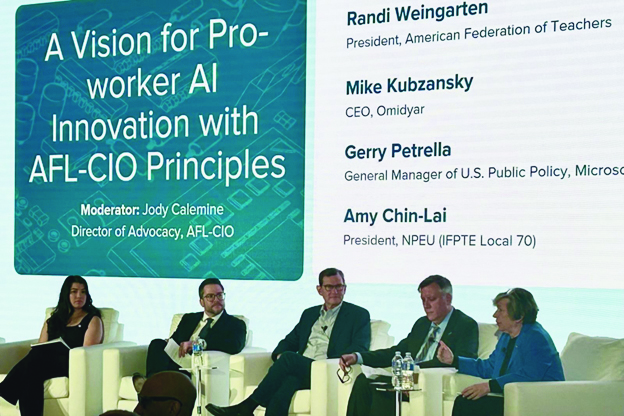
The Federation’s legislative effort builds on the AFL-CIO’s Workers First Initiative on AI, released in October 2025, which calls for bargaining rights, transparency, training, human review and safeguards for workers’ creative work and likeness. Shuler told Semafor the proposal would address worker protections, privacy, data protections and economic impacts.
Workers deserve notice and bargaining rights when technology changes their jobs. People must remain accountable for employment decisions, and workers need a way to challenge them.
From principles to contracts
Writers and performers have won some of the best-known AI protections. The Writers Guild of America’s 2023 agreement established that AI is not a writer and AI-generated output is not literary material under the contract. Studios cannot use an AI-generated screenplay to classify a writer’s assignment as a lower-paid rewrite. Employers cannot require writers to use AI and must disclose AI-generated material.
The 2026 WGA agreement retained those protections and added notice requirements when companies license scripts or productions for training commercial generative AI systems. The Guild can request discussions about those licenses, including compensation for writers.
SAG-AFTRA’s agreements protect performers against unauthorized digital replicas of their voices and likenesses. Producers generally must obtain informed consent, describe the intended use and provide compensation. Different projects or materially different uses generally require new consent.
The union’s 2025 commercials contract added compensation requirements for replica-generated performances and prohibits using performers’ data to train AI without union consent. Its video game agreement added disclosure and consent protections, including the ability to suspend consent for generating new material during a strike.
Behind the scenes, IATSE’s 2024 Hollywood Basic Agreement keeps AI-assigned work covered by the union contract. Employees cannot be required to write prompts that displace another covered worker. The agreement also provides training mechanisms, recurring employer meetings and bargaining over most effects of AI.
Requests to scan employees must appear in separate, clear documents. Consent cannot be a condition of employment, and the union must receive proposed consent forms before workers do. These protections keep consequential decisions from being buried in routine hiring paperwork.
Enforcement makes the difference
Journalists at POLITICO and E&E News demonstrate why contract enforcement matters. Their Guild, part of Washington-Baltimore News Guild Local 32035, negotiated 60 days for bargaining before management introduces AI that materially and substantially affects members’ duties. AI used for newsgathering must also meet newsroom ethical standards and involve human oversight.
When management introduced two AI-powered editorial products without honoring those safeguards, the union filed a grievance. In November 2025, an arbitrator found that POLITICO violated both provisions. In May 2026, management agreed to shut down the tools.
The NewsGuild-CWA reports that its bargaining units have ratified 58 contracts governing AI in newsrooms nationwide.
Effective protections reflect each occupation’s risks. Hospitality workers need retraining, transfer rights and severance. Journalists need accuracy standards and human oversight. Performers need control over their identities. Technicians need protection for bargaining-unit work.
Together, these gains establish a common agenda: advance notice, access to information, limits on surveillance, protection against automated discipline, specific consent, fair compensation and paid training. Grievance and arbitration procedures give those rights force.
Union members are writing AI protections into contracts. The AFL-CIO is working to put protections into federal law. Both efforts advance the same demand: workers must have the power to shape how AI changes their jobs.