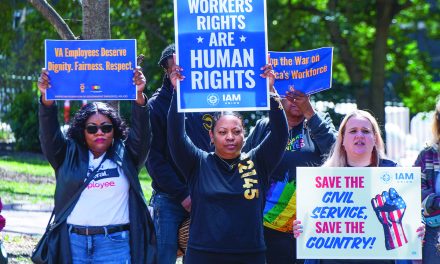
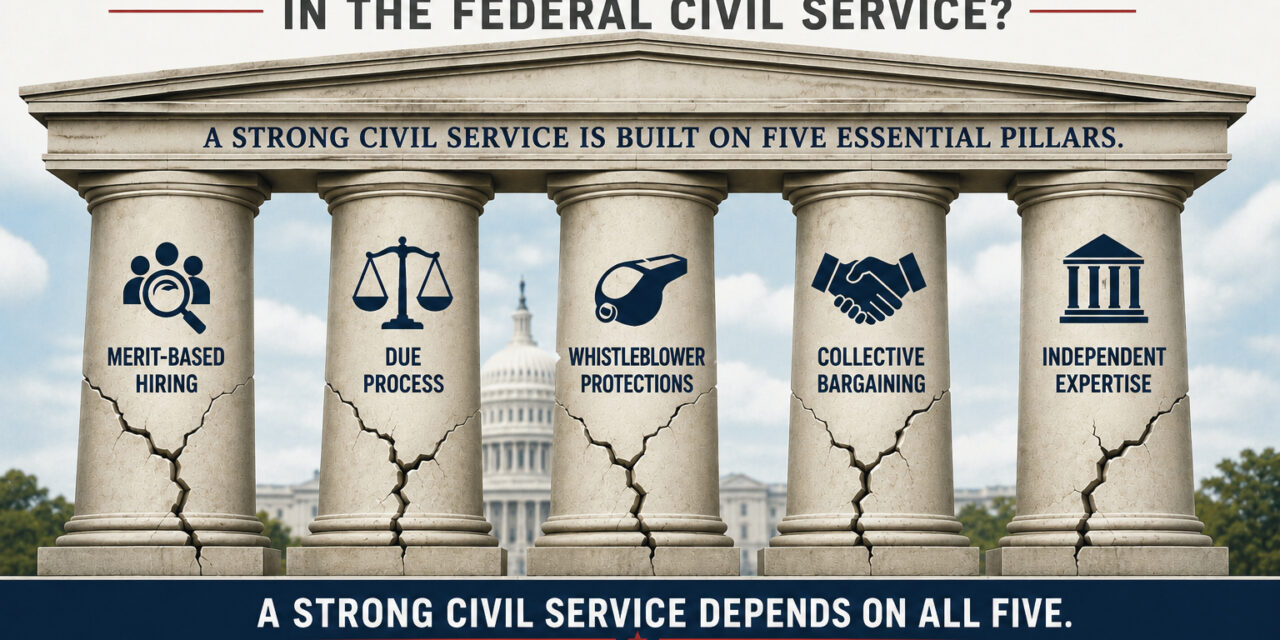
For more than 140 years, the United States has maintained a professional civil service based on a simple principle: federal employees should be hired, promoted, and retained based on merit, qualifications, and expertise—not political loyalty.
Today, that principle faces one of its most serious challenges in modern history.
The Trump administration has launched a sweeping effort to reshape the federal workforce through executive orders, personnel changes, restrictions on collective bargaining rights, and new policies that critics warn will politicize government service and undermine the independence of career federal employees.
Taken together, these actions represent a fundamental transformation of the federal civil service.
Schedule Policy/Career Reopens the Door to Political Patronage
At the center of that effort is the revival of Schedule F, now renamed Schedule Policy/Career.
In June, President Trump signed an executive order transferring approximately 8,000 career federal positions into the new excepted service category. Employees designated as Schedule Policy/Career can be removed more easily than traditional career civil servants and lose many of the protections that have long insulated federal employees from political pressure.
Supporters argue the change increases accountability. Critics argue it weakens the merit system and creates incentives for federal employees to prioritize political considerations over professional judgment. The concern is not simply that employees may be fired more easily, but that workers may feel pressure to align their professional recommendations with political priorities.
The modern civil service was created to prevent precisely that outcome. Federal employment was removed from the patronage system so government could be staffed by qualified professionals rather than political loyalists.
Weakening Whistleblower and Worker Protections
The administration has also proposed a government-wide nondisclosure agreement (NDA) that whistleblower advocates say could chill lawful disclosures of waste, fraud, abuse, and misconduct.
Particularly troubling is language that appears to omit the Office of Special Counsel from key whistleblower protection provisions. Federal law specifically protects disclosures made to Inspectors General and the Office of Special Counsel. Critics argue the omission could create confusion about employees’ rights and discourage use of one of the government’s most important independent oversight channels.
Federal employees are also being directed to install a new White House mobile application on government-issued devices. Critics have questioned why the app is necessary and whether it belongs on federal systems at all. Cybersecurity experts warn that every new application introduced across government networks creates potential security risks and should be subject to careful review before widespread deployment.
At the same time, Schedule Policy/Career employees lose traditional civil service appeal rights, and the administration has moved to curtail collective bargaining rights for hundreds of thousands of federal employees. Together, these actions reduce many of the safeguards that have historically protected federal workers from retaliation and arbitrary treatment.
A Workforce in Retreat
The cumulative impact of these policies is becoming increasingly difficult to ignore.
Federal agencies are already struggling to recruit and retain skilled employees. Experienced workers are retiring. Others are leaving for private-sector opportunities. Younger workers increasingly question whether federal service offers the stability, independence, and professional protections that once made government careers attractive.
The federal government competes with the private sector for cybersecurity professionals, engineers, scientists, healthcare workers, and countless other skilled employees. Recruiting those workers becomes substantially harder when job protections are weakened, collective bargaining rights are curtailed, and career employees can be reclassified as at-will workers.
Labor Leaders Sound the Alarm
Everett Kelley, President of the American Federation of Government Employees (AFGE), has warned that the administration’s personnel policies threaten to replace a professional, nonpartisan workforce with one increasingly subject to political influence.
“Schedule F is one of the largest acts of political corruption in American history,” Kelley said when the policy was first proposed, warning that federal positions could be filled based on political loyalty rather than expertise.
Federal employee unions across the labor movement have echoed those concerns.
What’s at Stake
America’s civil service exists to serve the Constitution, the law, and the public. It functions best when employees are free to provide honest expertise, report wrongdoing, exercise legally protected rights, and perform their duties without political interference.
The federal workforce deserves modernization, investment, training, and support. What it does not need is a return to a system where political loyalty matters more than professional expertise.
The future of the American civil service—and the quality of government services upon which millions of Americans depend—may well depend on preserving that distinction.