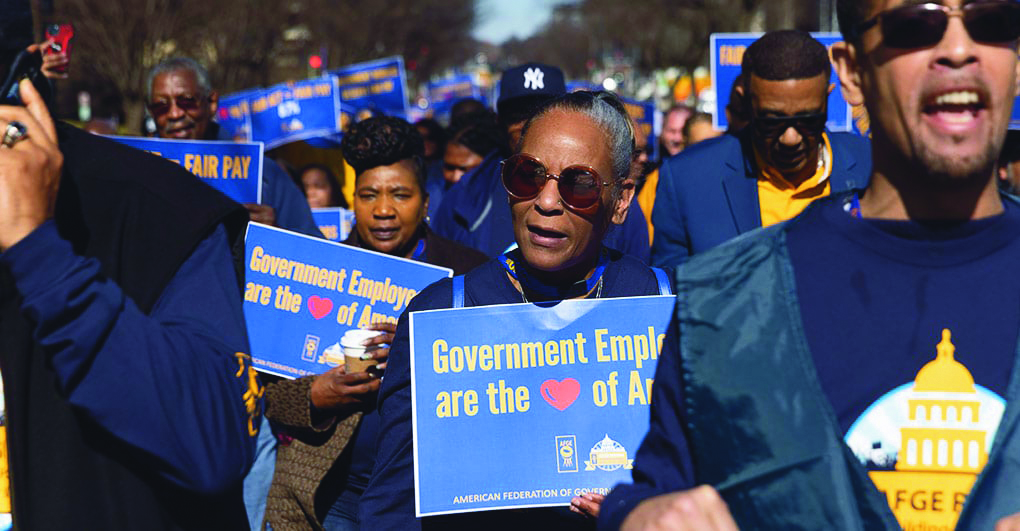
The American Federation of Government Employees has spent the last two years locked in one of the most aggressive fights for federal worker rights in modern labor history.
From battling mass layoffs and reductions in force to defending collective bargaining agreements, telework protections, due process rights, and union representation itself, AFGE has become the central legal and organizing force standing between federal workers and sweeping efforts to dismantle workplace protections across the federal government.
And despite enormous pressure, the union keeps winning critical battles.
AFGE’s strategy has been relentless: challenge unlawful actions in court, enforce collective bargaining agreements through arbitration, mobilize members publicly, and refuse to surrender bargaining rights agency by agency. That persistence has produced a series of major victories for federal employees, even as larger legal and political fights continue to unfold.
One of the most significant recent victories came at the Department of Veterans Affairs, where a federal judge ordered the VA to restore its collective bargaining agreement with AFGE’s National VA Council, covering more than 300,000 employees. The ruling found the administration’s attempt to terminate the agreement likely violated federal law and constitutional protections.
The VA fight did not end there. AFGE later returned to court accusing the agency of attempting to circumvent the judge’s order, prompting further judicial scrutiny and warnings regarding compliance.
At the Social Security Administration, AFGE secured another major win when an independent arbitrator ordered the agency to restore telework rights for thousands of employees represented by the union. The arbitrator found SSA had unlawfully repudiated provisions of its negotiated contract after the agency broadly suspended remote work arrangements.
AFGE achieved similar victories at the Department of Housing and Urban Development, where arbitrators ruled that management violated collective bargaining agreements by unilaterally rolling back telework protections. Those rulings ordered HUD to reinstate prior agreements and potentially compensate workers for commuting and dependent-care costs resulting from the changes.
The union has also remained deeply involved in broader national litigation challenging reductions in force, politically motivated terminations, and executive actions aimed at stripping bargaining rights from federal workers. AFGE has joined or led multiple lawsuits contesting layoffs, agency reorganizations, and mass contract cancellations across the federal government.
In one particularly important ruling earlier this year, a federal judge sided with AFGE in a case involving probationary employee terminations, finding that the Office of Personnel Management exceeded its authority in directing agencies to fire workers. AFGE described the ruling as proof that the administration could not simply discard civil service protections by executive fiat.
Battles Ahead Remain Enormous
AFGE and allied unions continue to fight executive orders that seek to remove collective bargaining rights from broad categories of federal employees under claims of national security exemptions. Some lower court victories have already been narrowed or temporarily reversed on appeal, and several major cases are still moving through federal courts.
At the same time, agencies continue appealing arbitration losses tied to telework and workplace flexibility. The SSA, for example, has already appealed the arbitrator’s telework ruling to the Federal Labor Relations Authority, signaling that even clear wins may face prolonged legal fights before workers see lasting relief.
The broader stakes are larger than telework alone.
What AFGE is defending is the idea that federal workers deserve enforceable contracts, due process protections, safe workplaces, and a voice on the job. The union’s ongoing litigation campaign has effectively become a frontline defense of the modern federal civil service system itself.
For many federal employees, the constant legal uncertainty has created anxiety about layoffs, reclassifications, union representation, and working conditions. Yet AFGE has continued to organize, litigate, arbitrate, and publicly challenge nearly every major anti-worker action affecting its members.
That persistence matters.
Because while some cases remain unresolved and appeals continue to pile up, AFGE has shown that organized workers can still force agencies and administrations to answer to contracts, labor law, and the courts. And in an environment where many federal workers feel under sustained attack, that tenacity has become one of the union’s greatest strengths.