
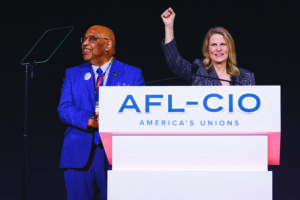
2026 Convention – Officer Elections – AFL-CIO President Liz Shuler and Secretary-Treasurer Fred Redmond Reelected!
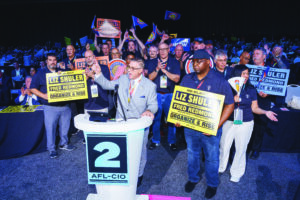
International President Kenneth W. Cooper of the International Brotherhood of Electrical Workers (IBEW) nominated Liz Shuler for reelection at the 2026 AFL-CIO Constitutional Convention.
Delegates representing 65 affiliated unions and approximately 15 million workers gathered in Minneapolis in June for the AFL-CIO’s 30th Constitutional Convention, re-electing President Liz Shuler and Secretary-Treasurer Fred Redmond while adopting resolutions that will guide the federation’s work over the next four years.
The convention served as both a celebration of labor’s recent gains and a strategy session for the challenges ahead. Organizing, economic policy, worker rights, democracy, and artificial intelligence dominated discussion throughout the week as delegates debated how organized labor should respond to a rapidly changing political and economic landscape.
Shuler and Redmond Re-Elected
One of the convention’s first orders of business was the re-election of Liz Shuler and Fred Redmond to another four-year term leading the nation’s largest federation of unions.
Shuler, the first woman elected president of the AFL-CIO, used her remarks to emphasize organizing and growth. Redmond, who made history as the first African American elected secretary-treasurer of the federation, focused on solidarity and the need for unions to continue building power across industries and communities.
Delegates also welcomed the return of the Service Employees International Union (SEIU) to the AFL-CIO, a move that expands the federation’s membership and strengthens cooperation among affiliated unions.
Organizing Remains Labor’s Central Mission
The dominant theme of the convention was growth.
AFL-CIO leaders announced a goal of helping organize two million new workers by 2031, one of the most ambitious organizing initiatives in the federation’s history. Speakers pointed to growing public support for unions and successful organizing campaigns across healthcare, logistics, retail, education, hospitality, manufacturing, and the service sector as evidence that workers continue to seek a collective voice on the job.
“Our movement is growing because workers know collective action works,” Shuler told delegates.
The organizing goal was reflected throughout the convention’s resolutions, many of which called for increased investment in organizing campaigns, stronger coordination among affiliates, and expanded efforts to reach workers in emerging industries and occupations.
Delegates repeatedly argued that organizing remains labor’s most effective tool for improving wages, benefits, workplace safety, retirement security, and economic opportunity.
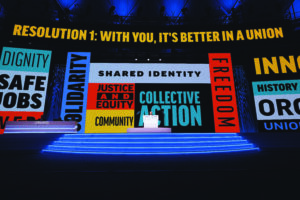
Day 2 of 2026 AFL-CIO Convention in Minneapolis – Resolutions
Resolutions Focus on Worker Power and Economic Security
Delegates spent much of the week considering resolutions that will shape AFL-CIO policy and advocacy efforts through the end of the decade.
Many resolutions focused on strengthening worker power in both the workplace and the broader economy. Delegates approved measures supporting collective bargaining rights, protecting workers’ ability to organize, expanding apprenticeship and workforce development opportunities, and promoting policies that create family-sustaining jobs.
Economic policy emerged as a major focus. Convention speakers argued that workers must share more fully in the wealth they create and that economic growth should be measured not only by corporate performance but by rising living standards for working families.
Several resolutions addressed domestic investment, manufacturing, infrastructure, retirement security, healthcare affordability, and workplace safety. Others focused on protecting voting rights, combating discrimination, and defending democratic institutions that delegates argued are closely linked to worker rights.
Throughout the debate, speakers returned to the idea that labor’s role extends beyond collective bargaining. Delegates described unions as institutions that help workers exercise a voice not only in the workplace, but also in their communities and in public life.
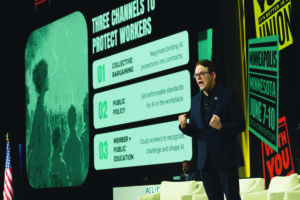
Duncan Crabtree-Ireland, national executive director and chief negotiator of SAG-AFTRA, addresses AFL-CIO convention delegates on the role unions can play in protecting workers as artificial intelligence reshapes workplaces across the economy.
Artificial Intelligence Emerges as a Defining Workplace Issue
No topic generated more discussion about the future than artificial intelligence.
Delegates adopted resolutions calling for a worker-centered approach to AI and automation, emphasizing that workers must have a voice in how emerging technologies are deployed in the workplace.
The resolutions seek greater transparency when employers use AI systems in hiring, scheduling, performance evaluations, discipline, or workplace surveillance. Delegates also supported policies requiring meaningful human oversight when technology is used to make employment decisions.
The debate reflected growing concern that AI could be used to weaken worker protections or eliminate jobs if implemented without safeguards.
Shuler has described artificial intelligence as a “right now issue” for workers, arguing that many employees are already experiencing the effects of AI in their workplaces. Convention delegates echoed that concern, while also recognizing the technology’s potential benefits when implemented responsibly and with worker input.
Rather than opposing technological innovation, labor leaders emphasized that workers should help shape how new technologies are introduced and governed. Collective bargaining was frequently cited as the mechanism best suited to balancing innovation, productivity, accountability, and worker protections.
The prominence of AI throughout the convention underscored how quickly the issue has moved from a future concern to a present-day bargaining challenge. As unions negotiate contracts and advocate for workplace protections in the years ahead, delegates made clear that artificial intelligence will remain a central focus of the labor movement’s agenda.