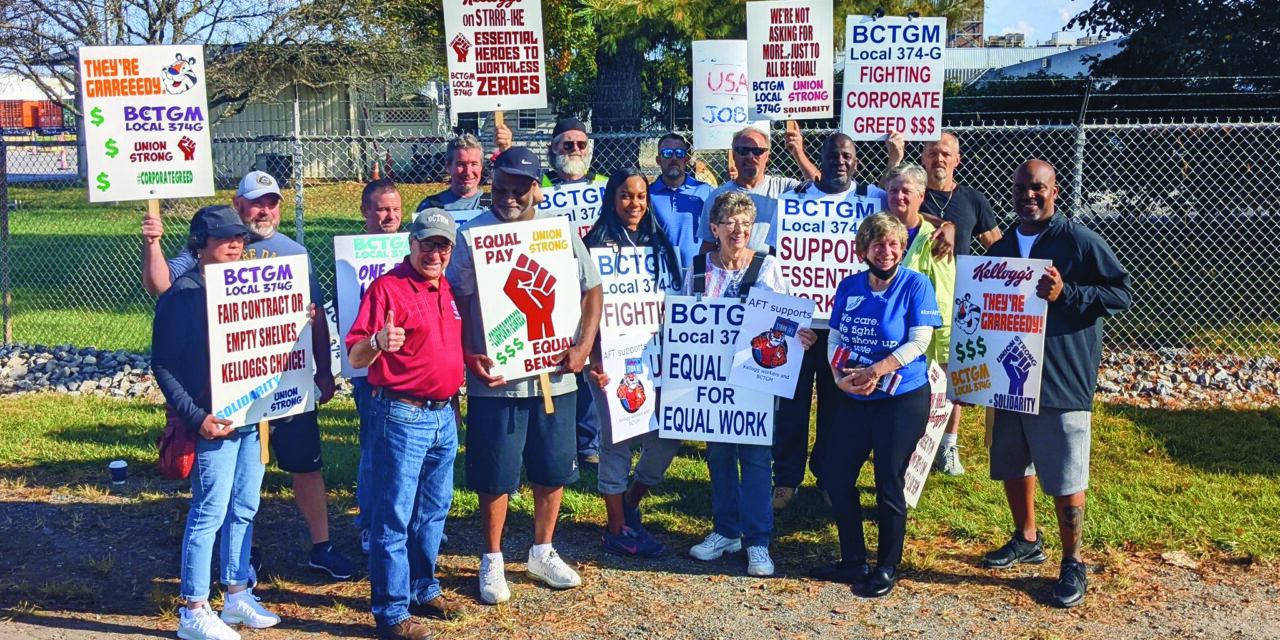
When workers at Bakery, Confectionery, Tobacco Workers and Grain Millers International Union walked off the job in the fall of 2021, they were not just fighting for wages, benefits, or job security. They were also defending something that often gets overlooked but carries real power in the marketplace: the union label.
The strike against Kellogg Company, which later spun off its North American cereal business into WK Kellogg Co, became one of the most closely watched labor disputes in the country. At stake were issues familiar across the labor movement, including a controversial two-tier wage system and the company’s long-term commitment to its workforce. But embedded in those negotiations was another fight, one tied directly to consumer awareness and union pride: the future of the “Union Made” label on cereal boxes.
Initially, the company proposed removing the union label from its packaging. That move would have stripped away a visible, everyday connection between the workers who make the product and the consumers who buy it. For BCTGM members, that was unacceptable. The union label is more than a mark. It represents fair wages, safe working conditions, and the dignity of skilled labor. Removing it would have erased that connection at the point of purchase.
After weeks on the picket line and sustained pressure from workers and allies, BCTGM members secured a landmark agreement in December 2021. The five-year contract included no concessions, a plant-closing moratorium, and meaningful protections for workers across the company’s facilities. Just as important, the agreement preserved the “Union Made” label on cereal boxes produced in the United States.
The resolution of the label issue did not stop at preservation. It went a step further.
At the time of the agreement, the company had already produced a significant number of cereal boxes without the union label printed on them. Rather than allowing those products to reach store shelves without recognition of the workers who made them, the agreement required the company to take corrective action. WK Kellogg Co committed to adding “Union Made by BCTGM members” to the top of those boxes, ensuring that even previously printed packaging would carry the mark of union labor.
Union Label More than Symbolic
That detail matters. It demonstrates that the union label is not symbolic window dressing. It is something worth negotiating over, enforcing, and protecting in concrete terms.
The importance of that fight was underscored again this April, when BCTGM International Secretary-Treasurer David Woods shared the story in remarks to the Union Label and Service Trades Department Convention. His account made clear that the label was never a side issue. It was a line in the sand. Workers understood that maintaining the union mark on products—and correcting boxes that initially lacked it—was essential to preserving the visibility and value of union labor.
For the labor movement, this outcome reinforces a broader point. The union label connects collective bargaining to consumer behavior. It gives working people a way to support one another beyond the workplace, turning everyday purchases into acts of solidarity. When that label is visible, it educates consumers and reinforces the value of union labor in a way that no press release or advertising campaign can replicate.
The 2021 BCTGM strike and the resulting agreement with WK Kellogg Co show what is possible when workers hold the line not just on traditional contract issues, but on the visibility and recognition of their work. They understood that if the label disappears, so does a powerful tool for building long-term support for union jobs.
They were right to fight for it, and they were right to win.
The union label is not an afterthought. It is a strategic asset. Protecting it at the bargaining table strengthens the connection between workers and consumers, reinforces standards across industries, and keeps the value of union labor front and center where it belongs.